


Can a Tankless Water Heater Run Multiple Showers?

Last Updated: November 2, 2026
Quick Summary
Yes, a tankless water heater can run multiple showers at once, but only if its GPM rating at your required temperature rise matches the combined flow of every fixture running. Two standard showerheads draw 5.0 GPM, so size the unit to deliver that flow at your winter groundwater rise, not at a lower one.
Two standard showerheads draw 5.0 GPM combined; two low-flow showers draw 3.0 to 4.0 GPM.
A unit rated 8.0 GPM at a 35°F rise may deliver only around 5.0 GPM at a 60°F rise.
Size for your coldest month using local winter groundwater, not the annual average.
Add 10 to 15 percent as a buffer to your worst-case morning fixture total.
A mixing valve blends hot output with cold to stretch capacity and protect against scalding.
Table of Contents
Tankless Water Heater Temperature Rise and Why It Changes Everything
Tankless Water Heater Sizing for a Shower: A Step-by-Step Load Calculation
Tankless Water Heater for Large Families: What Changes at Scale
Tankless vs. Tank: Which Handles Simultaneous Demand Better?
Mixing Valves, Recirculation Pumps, and Other Design Details That Matter
The Short Answer: It Depends on GPM and Temperature Rise
Yes, a tankless water heater can run multiple showers at once. Whether it does so well comes down to two numbers: flow rate in gallons per minute (GPM) and temperature rise.
The short answer is yes. The longer answer is that "multiple showers" means nothing until you add up fixture flow rates, subtract incoming water temperature from your target, and match both to a unit's capacity.
Below, we walk through a load calculation you can use to size a system, plus the design details that decide whether your system keeps up at 7 a.m.
Tankless Water Heater GPM for Multiple Showers
Start with the fixtures, not the unit. A tankless water heater's GPM rating tells you how much hot water it can push per minute at a given temperature rise. Two standard showerheads can draw several gallons per minute combined, and a third shower adds more to that total. Readers comparing capacity can explore Navien tankless models and their capabilities.

Adding Up Fixture Flow Rates
Modern showerheads are generally rated at 2.5 GPM or less, and many low-flow models run 1.5 to 2.0 GPM. Here is how a typical home stacks up:
One standard showerhead: 2.5 GPM
Two showers running together: 5.0 GPM
Two low-flow showers: 3.0 to 4.0 GPM
Two showers plus a kitchen sink: roughly 6.5 GPM
Two showers plus a washing machine: 7.5 GPM or more
That last line is the one people forget. A tankless unit sized for two showers alone will struggle the moment the dishwasher kicks on.
Here is how common fixture combinations add up in gallons per minute.
Fixture setup | Flow rate (GPM) |
One standard showerhead | 2.5 GPM |
Two showers running together | 5.0 GPM |
Two low-flow showers | 3.0 to 4.0 GPM |
Two showers plus a kitchen sink | roughly 6.5 GPM |
Two showers plus a washing machine | 7.5 GPM or more |
Tankless Water Heater Temperature Rise and Why It Changes Everything
Temperature rise is the gap between the cold water entering your home and the hot water you want at the shower. A unit rated at 8 GPM might deliver that full flow only at a modest rise. Push the rise higher and the same unit delivers less water.
Manufacturers publish capacity charts that show GPM at several temperature rises, usually 30°F, 40°F, 50°F, 60°F, 70°F, and 80°F.
Groundwater Temperature by Region
Incoming water temperature is not a national constant. It tracks local climate and how deep the supply line sits.
Take a target shower temperature of 105°F:
The required rise is the target temperature minus your incoming water temperature. Always size for your coldest month, not your annual average, and use your local winter groundwater figure rather than the summer number.
Watch out: a unit's headline rating may reflect the lowest temperature rise. If the spec sheet does not show a capacity chart across multiple rises, ask for it before you buy, the number you need is the one at your winter rise.
A Worked Example
Suppose two standard showerheads draw 5.0 GPM combined, your winter groundwater is 45°F, and you want 105°F at the shower. Required rise is 60°F. You need a unit that delivers at least 5.0 GPM at a 60°F rise. If you also want the bathroom sink (1.5 GPM) running at the same time, the target becomes 6.5 GPM at 60°F. That is a materially larger unit than the one a homeowner would pick by reading the headline GPM alone.
Tankless Water Heater Sizing for a Shower: A Step-by-Step Load Calculation
Here is the calculation we run on every consultation. You can do it yourself in about five minutes.
List every fixture that might run at once. Count showers, sinks, and appliances.
Add up their flow rates in GPM. Use the numbers on the fixture labels or the list above.
Decide your target shower temperature. Most people prefer 105°F to 110°F.
Find your incoming water temperature. Winter groundwater in this region runs cold, so use a conservative number.
Subtract incoming from target. That is your required temperature rise.
Match GPM and rise to a unit's rating chart. The unit must deliver your total GPM at your required rise, not at a lower one.
Tankless Water Heater for Large Families: What Changes at Scale
A family of six does not just need more hot water. It needs more hot water at the same time. Our water heater sizing guide walks through choosing the right size for a large household. Three bathrooms in use during the morning rush can push demand past 8 GPM, and that changes which units qualify, and often whether one unit can do the job at all.
Peak Hour Capacity and the Morning Rush
Peak demand is the real test. A tankless unit has no stored hot water to fall back on, so every fixture running at once counts against its capacity in real time.
A practical way to plan: write down the worst fifteen minutes of a weekday morning. Count every fixture that could plausibly run at once, add the GPM, and add 10 to 15 percent as a buffer. That buffer helps cover the gap between fixture label ratings and real-world flow, plus any drop in capacity on a cold winter morning.
When One Unit Is Not Enough
Homes with four or more bathrooms, or with simultaneous laundry and shower demand, often need one of three approaches:
A single high-capacity condensing unit. Gas-fired condensing models with high BTU input can reach the flow needed for three showers, but they require a larger gas line and often a larger vent. Confirm both before you commit.
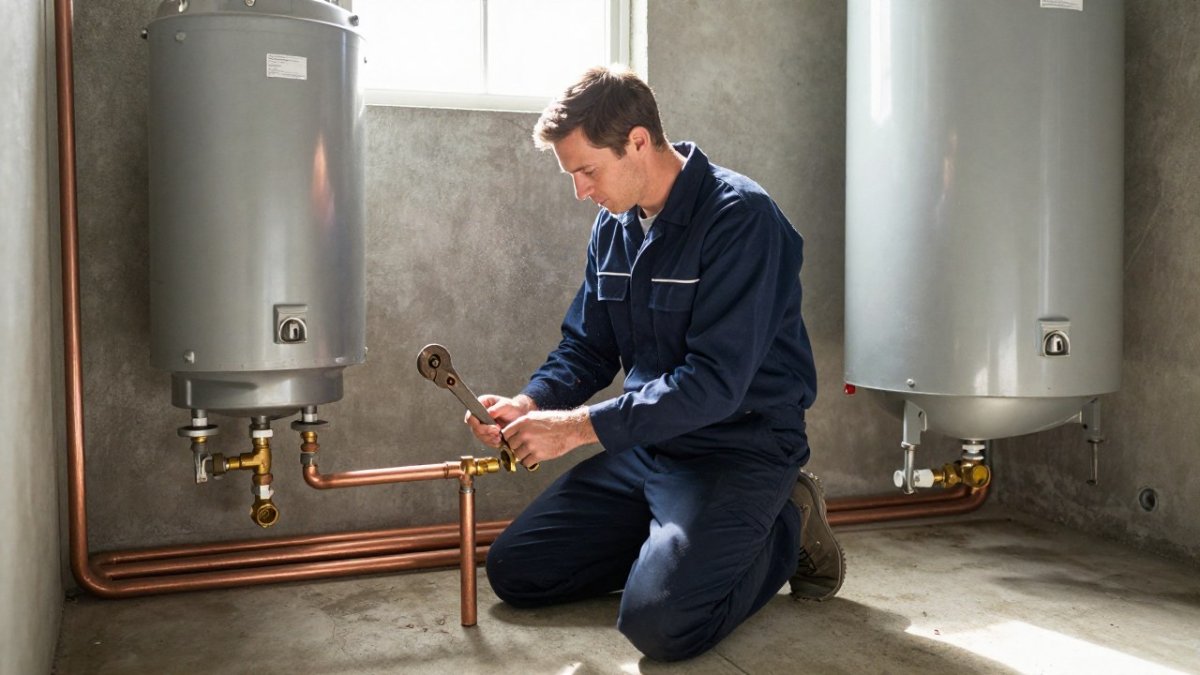
A manifold or twin-unit setup. Two tankless units plumbed in parallel split the load. Each unit handles part of the total flow, and if one needs service the other keeps hot water running. This is the common answer for large households with heavy simultaneous demand.
A hybrid approach. Keep a small storage tank downstream of the tankless unit as a buffer. The tank absorbs short bursts of peak demand, and the tankless unit reheats between bursts. This is often the least expensive way to serve a large family without a full utility upgrade.
Retrofitting an Older Home
This is where large-family projects most often go sideways. A high-capacity tankless unit needs more gas or electrical capacity than the unit it replaces. Older homes often need work in these areas:
Gas: the existing half-inch line may be undersized for a high-BTU unit. Upgrading to a larger line and confirming the meter can supply the added load is part of the project, not an afterthought.
Electric: whole-home electric tankless units can draw 100 amps or more at peak. Many older panels cannot support that without a service upgrade, and some homes are better served by a gas unit or a hybrid setup.
Venting: condensing units need a properly sized PVC or CPVC vent run; non-condensing units need stainless or category III venting. Confirm the route before the unit is ordered.
Watch out: when comparing quotes, check whether gas-line or panel upgrades are listed. Ask specifically what utility work the installation requires and whether it is included.
Maintenance at High Demand
High-usage units scale faster. In areas with hard water, a multi-shower household can build scale in the heat exchanger within a year, and scale cuts both flow and efficiency. Periodic descaling, flushing the unit with a vinegar or commercial descaler, is generally recommended for households with hard water, as scale can reduce capacity and efficiency. Skipping it is one of the most common reasons a correctly sized unit starts underperforming after two or three years.
Sizing a large family's system properly means planning for the worst fifteen minutes of the day, not the average.
Tankless vs. Tank: Which Handles Simultaneous Demand Better?
A traditional tank wins on stored volume. A 50-gallon tank holds hot water ready to go, so two showers can run back to back without a dip, right up until the tank empties and the recovery rate takes over.
A tankless unit wins on endurance. It heats water on demand and never runs out, as long as the flow stays within its capacity.
Which matters more depends on your habits. Three showers at 7 a.m. favor a properly sized tankless unit. If you are still weighing the switch, our tankless water heater pros and cons guide covers the full comparison.
Mixing Valves, Recirculation Pumps, and Other Design Details That Matter
Two accessories solve most high-demand complaints. A mixing valve blends hot output with cold water to stretch capacity and protect against scalding. A recirculation pump keeps hot water moving through the lines so showers heat up fast instead of waiting.
Watch out: skipping a mixing valve on a unit sized close to its limit can contribute to the "cold water sandwich," where temperature swings between hot and cool during a shower.
Other details that matter:
Gas vs electric: gas units generally deliver higher BTU input and better flow for multi-shower homes
Venting requirements: confirm your utility space can handle the unit's venting before you buy
Water hardness: hard water scales the heat exchanger over time, so plan for descaling
Pressure drop: long pipe runs and undersized gas lines cut performance even on a correctly sized unit
Book a Free In-Home Consultation and Get a Written Quote
Sizing a tankless system for multiple showers is a math problem, not a guess. Get the GPM and temperature rise right and your morning rush runs smoothly for years.
That is where we come in. Water Heaters Plus! offers free in-home consultations with a written quote, installation pricing on our website, and access to trusted brands including AO Smith, Bradford White, and Navien.
Get started with Water Heaters Plus! and get a system sized for your home, your fixtures, and your coldest morning of the year.
Frequently Asked Questions
Can a tankless water heater run two showers at the same time?
Yes, if the unit's flow capacity covers both showers at your incoming water temperature. Two standard showerheads at 2.0 GPM each need 4.0 GPM total, plus any other fixtures running. A tankless water heater rated for that flow at your temperature rise will handle it. Undersized units will drop pressure or deliver lukewarm water when the second shower starts.
How do you calculate the GPM needed for multiple showers?
Add the flow rate of every fixture running at once. A standard showerhead uses about 2.0 GPM, a low-flow model 1.5 GPM. Two showers plus a bathroom sink come to roughly 5.0 GPM. Then match that number to the unit's GPM rating at your actual temperature rise, not the higher number on the box label.
Why does the water turn cold when two showers run at once?
On a tank system, the stored hot water runs out faster than the burner or element can recover it. On a tankless system, the cause is usually a flow rate that exceeds the unit's capacity at the current temperature rise, so the heater modulates down or shuts off. The cold water sandwich, a burst of cool water between draws, is a related issue.
What size tankless water heater do you need for a large family?
Size for peak demand, not average use. Count the fixtures likely to run during the morning rush, add their flow rates, and calculate the temperature rise from your inlet temperature to 120°F. Families with three or more bathrooms often need a condensing unit with higher BTU input, or two units in a manifold system, to avoid capacity shortfalls.
Comments